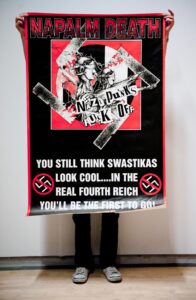
The Anti-Fascist Core of Napalm Death

For nearly 40 years, Napalm Death have remained one of the loudest anti-fascist and most consistent voices in global heavy music. This piece is built on quotes from interviews given by the band’s musicians over the years. They allow us to trace how the ideas of street-level resistance to neo-Nazism evolved into a philosophy of non-violent opposition, without ever losing their essence.
Finland holds first place in the world for the number of metal bands per capita — about 2,800 bands for a population of 5.2 million, making it the global leader in the density of the metal scene. Festivals like Tuska Open Air in Helsinki (with an audience of about 60,000 people in 2025) regularly invite Napalm Death to their stages alongside other significant performers. Despite the commercial scale of such festivals, they offer an excellent platform for political statements, and the band actively uses it to promote its anti-fascist stance before a large audience. Napalm Death’s popularity in Finland is sufficient — the band has a strong fan base among fans of extreme and underground metal. For the Finnish rock audience, Napalm Death is one of the pillars that laid the foundations of the genre. Their influence on the Finnish scene is undeniable: Rotten Sound from Vaasa — the leading Finnish grindcore band — released an EP consisting entirely of Napalm Death covers in 2010 and to this day cites them among their primary influences. They have also toured together and belong to the same grindcore tradition.
In 1987, when Napalm Death released their groundbreaking debut “Scum”, the band’s political stance was already clearly defined. In an interview that year, guitarist Jus (Justin Broadrick) described the UK environment that shaped them: “Well what can I say about the UK, um, a shithole, full of apathetic turds, a lot of racist shits, nice countryside, a fascist government, etc.” The band’s songs carried an explicit political charge from the very start: “Lyrically the whole shitty world influences us, band that influence our lyrics are Crass and the like.” When asked directly about politics, his answer was unequivocal: “It fucks lives.” Bassist Shane Embury spoke about the childhood environment that shaped his worldview: “Where I was born it was a really, really, really small village, you know, very quiet… Everyone knows everybody. It’s kinda sad in a way, ’cause everyone is sortof very much expected to do the same, you know, sortof tradition… Very narrow-minded, and I found it very racist. In the village I was brought up in actually there wasn’t one black person. That was kinda sad actually.”
When Mark “Barney” Greenway became vocalist in 1990, the band’s anti-fascist stance became even more pronounced. The early American tours were baptism by fire. Years later, Barney recalled them like this: “The first two tours of the U.S. we did were fucking miserable, if I’m honest, because we were coming into conflict every other gig, even in places where you might think they’d be a bit more tolerant. It was everywhere. It was almost trendy to be in an Aryan gang. They would either wanna fuck with the band, or they would wanna fuck with the fans, because they would wanna take over the audience. And it wasn’t acceptable, I just wasn’t fucking having it. We needed to stand up and do something about it, and that led to a lot of conflict and some really fucking dangerous situations. But I just couldn’t let it lie. It’s not about me, it’s about the people that are there, that shouldn’t be getting their fucking heads punched in.”
In a 2015 interview with Metal Insider, Barney gave more detail about those dangerous tours: “In America it was. We would be tearing up the venues, looking for the escape routes, what we would do if, or if we couldn’t escape how to fight our way out of a situation. It fucking rough you know you had all those bands, to be honest, they didn’t even know why they were doing it or what they were singing about. It just became a bit of a youth movement. There was also some connection with the straight-edge movement as well. There was a lot of really right-wing straight-edge kids. The two kind of molded into each other. So you had either this ultra-right-winged side, a sea, within the sea. Then you also had a lot of idiotic, jock behavior, like kids bringing pool balls in socks into venues and going into the pit and fucking smashing people. It’s fucking stupid stuff. It was not fun at points.”
In June 1993, Napalm Death made their position explicit by releasing the “Nazi Punks Fuck Off” EP — a cover of the Dead Kennedys’ classic single from ’81, which was a sharp critique of the presence of neo-Nazis and fascist attitudes within the punk scene. As later documented: “Napalm Death – being of sound mind, judgement and just y’know, not being arseholes – had already made the world very aware of their stance on nationalist socialism.”
The most infamous confrontation occurred in 1994 at Rock Summer-94 festival in Tallinn. The incident involving Russian band Korroziya Metalla became a legend of the musical underground thanks to media coverage. From the Kerrang report: “I said, ‘Why have you got song titles like Kill All The Bloody Foreigners then?’ Their reply to me was, ‘Do you like Turkish people as well then?’ I just walked away in disgust.” “Their guitarist asked to do an interview with Napalm Death. I told him I didn’t do interviews with Nazis. He pushed me, I pushed him, and Shane [Embury, Napalm bassist] jumped in and gave him five in the head! It all went off from there and turned into a massive brawl.” “To be honest, I wish I’d killed him.”
In a 2002 interview, Shane Embury clarified the band’s relationship with politics: “We want people to think a little about what is happening around them, what is happening in this world in general. Our planet is certainly sliding into complete chaos, but still… try not to drown in this stream. Be Individuals and be able to make individual decisions.” “Absolutely. ND is a political band, although this doesn’t necessarily apply to every member. I, for example, don’t consider myself a politician, preferring not to spread my opinions and ideals but to keep them to myself. Barney is different… He loves political discussions.” By 2015, Barney’s views had become more nuanced. In the Metal Insider interview, he discussed his absolute opposition to capital punishment: “People that know me and you might have read interviews with me, questions have been asked and I’m completely against the death penalty. In any way, shape or form. It’s no deterrent for anything and most importantly if in this world the idea is to arrive at solutions for the good of humanity the death penalty is not one of them. It doesn’t break the cycle of violence or aggression.” He even wrote letters to the Indonesian president about death row cases: “How could I turn away from something like that knowing somebody was on death row? I could maybe do something small to push it.” His stance on free speech versus fascism had refined: “The one thing I will say, whilst I abhor that kind of thing, I also respect that people should have the right to say whatever they want, as offensive as it might be. I do respect their right to say it. It’s just when you’ve lived in Europe with the history of the 1930’s and the great proliferation of right wing groups in Europe right now it’s pretty scary right now. You get very fucking nervous when those people start to organize. If it goes too far, there’ll be a fucking civil war like there was in Spain in the 30’s with people going to fight fascism from all over the world, descending on Spain and fighting General Franco and Hitler.” “I can say my views have refined a little bit. I think that everybody has the right to whatever opinions they want. No matter how ignorant it might be. I think that once that becomes hazardous or oppression, or when it’s allowed to manifest itself in physical form, into intimidation, like murder in some cases, then that’s a different story. I consider myself to be a pacifist. I wouldn’t fight anymore, I’m done with it. We were talking about the cycle of violence, and I’ve got to live by my own example and not commit violent acts. I try to live by that book. I would be sorely tested if we had that situation in Europe again, because I couldn’t accept living in a fascist state.”
The same year, in a VICE interview, he described a symbolic act of protest in Russia: “Yes, I do have one, I wore it [a Justin Bieber T-shirt] in Russia because I thought it looked quite effeminate, and I wanted to look quite effeminate because they just passed that stupid law to ban promotion of non-traditional sexual practices. It’s quite silly, and I wanted to let them know how stupid their law was.” Barney also addressed the term “PC”: “I think that the whole term itself, ‘PC,’ has always been a very convenient term to attack people that actually care about people, and care about treating other people with dignity, you know? It’s absurd.”
In January 2017, Barney gave an extensive interview in Japan, discussing nationalism as a global phenomenon: “Mate, it’s everywhere, it’s not just across the Western hemisphere. This is the mistake that people make sometimes, that they don’t realise that nationalism is fucking rampant in other countries. It fucking is man. You go to Japan, you look at the anti-Chinese, anti-Korean sentiments in Japan… A lot of other countries across Asia where certain other minorities are rejected, look at what happened in Myanmar to the Muslim population there; they were completely fucking burned out of their homes, murdered. Look at what happened to the Tamils in Sri Lanka, this isn’t exclusive to the Western hemisphere it’s fucking everywhere. Governmental nationalism can be powerful in any country across the world, it’s not a western thing, and people should understand that it’s not exclusive to this part of the world.”
In 2017, against the backdrop of Trump’s election and a sharp rise in far-right activity in the US, the band released a Nazi Punks Fuck Off T-shirt series, directing proceeds to the Southern Poverty Law Center, which monitors and documents the activities of extremist groups, and the American Civil Liberties Union, which works to defend civil liberties. Both organizations found themselves at the center of a broad wave of public support at the time — citizens and cultural institutions across the country directed funds to them as a symbolic and practical response to the political shift. “I struggle with it sometimes. I’m sure a lot of people would say this, but I’m really an advocate of free thought. If you really think that way, then that’s your choice, you know. But the trouble is especially when you look at the era where fascism was allowed to prosper in the 1930s, it went unchecked. And the consequences for large sections of the population were disastrous, so therein lies the issue when it comes to it.”
In a February 2020 Rock Sins interview, Barney clarified what activism means to him: “It’s not a fashion accessory. A lot of people use the term activism, which I’m a little bit uncomfortable with because it almost sounds like a jacket that you put on a hook, that you just put it on when you wanna get things going a little bit. I don’t wish to be demeaning to anybody, but for me it’s more of a lifetime thing. See I don’t have periods of activism personally, my whole perspective is dedicated to people being equal, people living with dignity and being treated as such. That’s where I am as a person. So yeah, those shirts do say something but then it’s not like ‘Oh I’ll stick on my Antifa shirt to look good today’, it has a real essence to it of realising what certain things, certain systems can do.” On current politics: “I mean, here’s the thing, I don’t know Boris Johnson personally so I can’t say whether he actually is [racist] or not, but power leads people to do things that are fucking pretty despicable and he has done some fucking despicable things along those lines, so therefore I wouldn’t be fucking surprised if there was an element of that within him.” “It’s fucking people we’re talking about. This is not like anonymous collections of matter this is people like me and you. Cut them some fucking slack. Our ancestors went into those countries and fucking completely stripped them of resources, erased their cultural identity in some ways, and you don’t expect that those people across the ages are going to want to come and settle in the country that took them over?”
Later that same year, in an interview with the MetalSucks podcast, Barney expanded on these themes: “My thing really, specifically with this album [Throes of Joy in the Jaws of Defeatism], was we have a certain atmosphere within the world right now. We’ve gone very much towards populism, protectionism, nationalism. And I find that really disquieting, to put it mildly. (…) With those things that I mentioned, the offshoot of that is there is a separation of peoples, there is a discrimination and dehumanization of certain peoples that’s just accentuated because of that populist, nationalist, protectionist sentiment. (…) The first one is migrants. Migrating peoples or refugees, who are quite frankly, very much dehumanized. They are considered to be lesser beings just because they’re trying to escape from really shitty situations to which if we were in their shoes, we would do exactly the same thing. And to shut these people out behind walls, to deny them the basic fundamentals of dignity, of survival. I think it’s just inhumane. (…) The second example I’m going to use is LGBTQ+ people. There’s a particularly ludicrous thing that’s used against them where the biology, the makeup of someone that is LGBTQ+, because of their whole sexual makeup, their biology is kind of different, and they sort of consider their gender differently. So there’s a suggestion that that difference in biology is somehow a threat to the biology of the rest of the population. You can hear this, even governments are using this kind of language right now, even governments are putting policies in place. There are a couple in Europe right now. Poland, for example, has so called ‘gay-free zones’ actually established within the country as legitimate government policy. I mean, this is fucking insane. (…) I’m very careful about using this word because I think it can be overused sometimes where it doesn’t recognize the real high-end proponents of it — but it is fascist ideology. The whole idea of scapegoating peoples based upon whatever’s going on in their life, and they might be escaping tyranny, or their sexuality, their biological makeup, its fucking insane to think that this stuff is being propagated even by governments. And you should be very fucking disquieted at the very least because if we remind ourself, this is the likes of Franco, Hitler, Mussolini, this is how they started, dehumanizing smaller groups of people and then building up to the big prize which is of course when murder and mass murder started to happen. (…) The antithesis from the angle of Napalm Death is to just simply stand up and say ‘no, this is not acceptable.’ This is our fellow human beings you’re talking about. After all this time of being on this earth and all the lessons we’re supposed to have learned, it’s come to this fucking point again.”
Shane Embury echoed these sentiments in an interview with Socialist Worker the same year, describing the central theme of the album: “The theme is basically the other — the treatment of the other. Not just the Black Lives Matter movement but the general treatment of people who are Afro-Caribbean or South Asian, the treatment of transgender people. Its also about emigration and migration. The world wouldn’t be as it is in many positive ways without migration.”
Throughout all these years, Napalm Death have consistently moved away from political labels. In recent interviews, Mark “Barney” Greenway expressed his attitude to mainstream politics: “Napalm often gets called a political band, and I’d be stupid if I said otherwise, but I also feel we’re apolitical, and we transcend politics. Because unless the ideas that we’re talking about are done in the world, and improve the prospects of everybody in this world, politics is fucking meaningless — it’s just token gestures. (…) I grew up on left-wing ideas. My father was a trade unionist. From an early age I understood that the world is unequal and that it shouldn’t be. But then I came across bands like Crass, Conflict, and began to understand: if politics doesn’t liberate people, it’s worth nothing. Crass understood that perfectly — they never aligned with either left or right. (…) The whole essence of where Napalm draws its ideas from is genuine freedom, anarchy in some sense. Peaceful anarchy. That’s where my path leads.”