
Uniform of Ideas
The history of protest style spans two and a half centuries. In it, aesthetics, tactics, and the economics of resistance are intertwined.
At the end of the 18th century, during the Great French Revolution, members of the sans-culottes civil movement wore red Phrygian caps and long working trousers.[1] This was a challenge to the aristocracy and a signal to their own. A century later, Russian nihilists recognised each other by blue spectacles and rough cloaks. And the educated female student revolutionaries among them wore short-cropped hair and short dresses in dark tones. In this way, they demonstrated a rejection of traditional femininity.
Today, not all activists attach importance to clothing. For many, the lack of attention to appearance and the free exchange of items is a normal practice of resistance to excessive consumption. Anarchists quite often organise Free-markets, where they bring all unnecessary things and where you can not only update your wardrobe but also find anything: from a teapot to an electric guitar. But for those who consciously select clothing based on functionality and symbolism, each element of the wardrobe can serve simultaneously as a tool and a statement.
After the end of the Second World War, the USA entered an era of economic prosperity and strict social conformity. The Cold War, McCarthyism, and racial segregation created an atmosphere in which dissent was perceived as a threat. By the end of the 1950s, writers and poets called beatniks began to openly reject materialism, bourgeois morality, and state control over consciousness.[2] Their ideas formed the basis of the mass movement of the 1960s – hippies, who turned the protest against the Vietnam War into a way of life. The hippie style featured deliberate carelessness and a mixture of different cultural motifs: Native American, African, Indian elements, ethnic patterns, saturated, almost acid colours, referencing psychedelic experiences. Their visual code symbolised freedom, spirituality, and rejection of established societal norms. Jeans, bright shirts, and loose maxi-dresses with floral prints became emblems not only of hippies but of the entire protest generation of the 1960s–1970s in the USA. This brightness and layering contrasted with the more restrained styles of previous generations. It became an important part of their political self-expression.
In the 1970s, punk emerged, whose style was built on the tactic of détournement.[3] This was a conscious strategy borrowed from the intellectual tradition of the Situationist International.[4] The essence of the method: take a symbol of power, commerce, or bourgeois morality and turn it inside out. This exposes the hidden violence or absurdity of the system. A swastika superimposed on an inverted image of Christ on the cross. A portrait of Queen Elizabeth II with a safety pin piercing her lips. Pornographic images on T-shirts worn on the streets in broad daylight. Fetish clothing from private bedrooms – bondage straps, zips, rubber, and leather turned into everyday street fashion. Each of these elements worked like a cultural bomb. Punk took what society hid, was ashamed of, or considered sacred, and put it on display. This forced people to react sharply: to be outraged, frightened, to ask questions. The wearer of such clothing became a walking scandal, a living provocation.
The method spread not only to symbols but also to the construction of clothing itself. Seams and labels were turned outwards. This showed what is usually hidden: the production process, the factory underside of a beautiful item. Jumpers were knitted so loosely that the body was visible through them. This blurred the boundary between being clothed and naked. Fabrics were deliberately torn and then fastened with safety pins. Not because there was no money for new ones, but as a statement: we refuse to play the game of ‘decent appearance’. We show the decay of the system through the decay of the material. The Situationists considered bourgeois culture a disease. And destructive creativity – a cure. If culture is sick with conformity and consumption, then anti-art and anti-fashion become a means of diagnosis.
The DIY approach, which became the cornerstone of punk ethics, also grew out of this logic.[5] If anyone can take an old T-shirt, write a slogan on it with safety pins and bleach, tear it, and wear it – then designers, tailors, and fashion factories are no longer needed. The production of style is democratised. It is taken from the industry and returned to the streets. This was an act of sabotage against the system that sells identity through brands and labels. Détournement destroyed the very idea that style can be bought. It proved that it can only be made – with your own hands, from rubbish, from negation.
The London shop Let It Rock / SEX / Seditionaries operated as a countercultural laboratory.[6] Designs were created there that attacked societal taboos and tested the limits of the permissible. The shop’s windows were smashed countless times by conservative citizens. The police often escorted customers from the metro to the door besieged by guardians of norms. Inside, the saleswomen interrogated clients: ‘Why are you buying this? What does it mean to you? You’re not buying a thing – you’re buying a work of art, an act of resistance.’ Every outing onto the street in such clothing became a political act. It was here that Vivienne Westwood and Malcolm McLaren articulated the visual language of punk. They dressed the Sex Pistols and their crowd, and this style quickly spread throughout the subcultural scene.
The irony is that punk style was quickly recuperated by the system it was directed against. Shops around the world began to copy the most harmless designs, punk became a fashion trend, and the creators themselves discovered that their détournement quickly turned into a commodity. Guy Debord in ‘The Society of the Spectacle’ described exactly this mechanism.[7] The spectacle absorbs any criticism directed at it and turns it into yet another image for consumption. Thus, it neutralises protest through its own visual form.
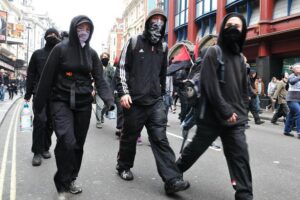
Inheriting these layers, squatters-autonomists who emerged immediately after the short punk revolution at the turn of the 1980s formed an ‘anti-style’, where functionality takes precedence over decoration. A black hoodie hood, a bandana around the neck that turns into a face-covering mask in seconds, dark glasses (or swimming goggles in case of police gas attack), a balaclava – all this was not fashion clichés but tactical elements of the costume. They helped hide the face from cameras, protect eyesight, suppress individual differences, and act as a unified collective. The genesis of the Black Bloc tactic dates back to West Berlin in the early 1980s, where squatters resisted mass evictions.[8] ‘Black Friday’ on 12 December 1980 became the first documented case: 15–20 thousand people in black clothing destroyed a shopping district as a sign of protest. During Ronald Reagan’s visit in 1987, about 3000 activists as part of a 50-thousand-strong demonstration used black uniform as a tactical solution.[9] By the end of the 1990s, the practice spread across the ocean: 500 participants in Philadelphia in 1999, 100–300 in Seattle during the multi-thousand protests against the WTO.[10] Such a black costume has a dual function. It protects the activist from police identification and at the same time facilitates coordinated attacks on symbols of capitalism – bank windows, corporate offices, surveillance cameras, expensive cars.
Baggy unisex clothing reliably hides the figure and external biometric markers. Some activists alter their gait: adding weights to belts or shoes to counter gait recognition technology.[11] The evolution of protection against surveillance demonstrates the technological arms race between activists and the state.[12] Previously, tattoos and scars were hidden from video and photo recording. Now, ears and noses are masked as reference points for identification. Eyes still remain the main source of data for modern AI-based recognition systems. Therefore, dark glasses and masks are critically important. The choice of glove material also matters. Organic fabrics absorb pepper gas and require immediate replacement. Synthetics melt from hot objects but do not absorb gas, making them preferable for mass street actions. The psychological aspect of anonymity is no less important. The mask erases skin colour, gender, age. Thus, collective action is cleansed of personal motives and biographies. Many participants stay in the crowd not for their own ‘illegal’ actions. But to protect those who commit them. They consider these actions ethically justified even if legally prohibited.
Contemporary antifa – activists of the decentralised antifascist movement – adhere to the same principles of functionality in clothing. Cargo trousers provide spacious pockets, and sports models – freedom of movement. Army boots or sturdy trainers protect and provide support in an urban environment. Gloves hide fingerprints. And in the backpack, there can be anything – from a first-aid kit, tools, and communication devices to ‘rescued’ food from a supermarket bin. Often, the backpack is replaced by a bum bag – a compact analogue convenient for short walks or attending cultural events. Every detail of such a costume is thought out in relation to possible street confrontation and mobility. The hood and mask here function both as symbols of solidarity and as technical solutions. They minimise identification, protect against poisonous substances, and erase individual differences. When many people look the same, it is impossible to single out individual participants – thus, the mass turns into a tool of protest.
Among the politicised subcultures of the second half of the 20th century, skinheads were the most attentive to clothing. They emerged at the end of the 1960s in London’s working-class districts under the influence of mods with their cult of neatness and Jamaican rude boys, who brought ska, reggae, and a specific way of dressing.[13] Every detail in their clothing was functional. A short haircut and a collarless jacket did not allow an opponent to grab hold during a fight, as did narrow rolled-up jeans. Heavy Dr. Martens boots or work boots with steel toes served as weapons. At the same time, skins cultivated neatness and a ‘smart’ look: Fred Perry polos, Ben Sherman shirts, Harrington jackets or light satin bombers, braces.[14] The brands were expensive, but the subculture was built on cheap analogues from markets like Petticoat Lane and second-hand shops.
In the 1970s, economic crisis, unemployment, and the growth of immigration created fertile ground for radicalisation. Far-right parties – primarily the British Movement – saw in skinheads a reserve for recruitment. They opened clubs only for party members, organised free events for youth. Thus, a significant part of the movement fell under the influence of Nazi propaganda and was drawn into street violence against migrants. At the same time, the media began to use the word ‘skinhead’ as a synonym for ‘racist’ – even if the criminal did not belong to the subculture. Neo-fascists captured the public image of the movement, although it was never homogeneous. Parallel to this, apolitical skins existed. And later, anti-racist groups like SHARP and RASH emerged.[15] They fought for a return to the multicultural roots of the ‘spirit of ’69’.
After the split in the skinhead community, clear markers formed. The colour of laces as a small detail, noticeable only up close, came to denote a specific end of the political spectrum. Items of certain brands signalled the ideological affiliation of the ‘wearer’. Neo-Nazis used more sophisticated codes. Under an unbuttoned jacket, the Lonsdale logo on a hoodie showed only the central letters ‘nsda’ – a reference to the abbreviation of Hitler’s party NSDAP.[16] The Italian brand Consdaple went further, where the abbreviation was read in full. Some logos changed their symbolic meaning within subcultures. They acquired ideological interpretations. For example, the company Kappa chose for its logo a silhouette from a random photo: a man and a woman resting back to back. Far-right activists began wearing Kappa tracksuits. They interpreted the logo as a symbolic image of a traditional family. New Balance products gained popularity in the same circles. The N letters on the sides of the trainers were deciphered by them as Nazi. Over time, this code became vulnerable. Items from ‘hostile’ camps fell into the hands of opponents as trophies or were used for disinformation. Visual identification lost its former unambiguity.
The attempt to build political identity on someone else’s trademark was doomed from the start. After all, brands cannot be controlled. They are appropriated by the market, and as a result, ‘skin’ items are worn by random buyers. These brands are suddenly advertised by celebrities with opposite views. Companies no longer ignore attempts to make their products markers of racist ideology: they either ‘clean’ their image or use the scandal to increase sales.[17] Logos serve capital, not the movement. The brand always belongs to those who control production and distribution, not to the consumer of the ‘branded’ goods.
The visual code of protest proved so attractive to youth seeking themselves in street politics through lifestyle and action that it became an object of appropriation by ideological opponents. At the beginning of the 2000s in Germany, the Autonome Nationalisten movement emerged – neo-Nazi groups that strategically copied the entire visual language of left-wing autonomists: black clothing, masks, hoods, ‘keffiyehs’, graffiti banners, black-red flags, and even recognisable antifa symbolism.[18] This was not a tribute or cultural borrowing. It was a conscious attempt to intercept youth disappointed in the mainstream. They sought a place in street politics but did not find it in traditional right-wing structures due to outdated and repulsive aesthetics. The reasons were pragmatic and strategically calculated. Left-wing autonomists dominated youth countercultures and controlled urban spaces thanks to the effective Black Bloc tactic. Far-right activists were losing in street clashes and losing potential supporters. Traditional aesthetics were outdated and no longer worked as a tool for attraction. Copying the left-wing visual code became both a military necessity and a marketing ploy. Young people came ‘almost non-political’. They were attracted by the rebellious aesthetics and the possibility of action. And the ideological content was filled in afterwards. Researchers are unanimous: the attractiveness of Autonome Nationalisten was created through action and lifestyle, not through ideology. People were attracted by the very possibility of being part of something that looks like resistance to the system.
Paradoxically, this mimicry caused a serious conflict within the right-wing movement. The NPD, striving for legitimacy in mainstream politics, publicly distanced itself from Autonome Nationalisten.[19] It feared that the ‘leftist’ image would undermine its respectability and scare away voters. Old cadres were outraged by the betrayal of traditions and the blurring of boundaries between ‘us’ and ‘them’. But the tactic had already worked. AN proved in practice that style works independently of ideology. That the visual code can be separated from political content and used for opposite purposes.
The right-wing attempts to fully appropriate the Black Bloc aesthetics ultimately failed on a mass scale. The association of ‘ninja style’ with radical leftists was too strong. And in the mid-2010s, the right turned in another direction. They began to develop the so-called preppy tactic.[20] Identity Evropa, participants of the Unite the Right rally in Charlottesville, and Proud Boys chose polos, chinos, loafers – the aesthetics of respectable young Republicans and harmless middle class instead of aggressive symbolism.[21] This was a continuation of the same strategy of normalising hatred that was started by Ku Klux Klan leader David Duke.[22] He replaced white hoods with suits and ties. The goal remained the same: to look not like ‘scary bikers’ or skinheads with swastikas, but like harmless, calm, and neat young people. To attract new supporters without standing out among ‘ordinary’ people.
But from the 2020s, the situation changed again. A transnational network of Active Clubs emerged – MMA groups of white nationalists founded by American Robert Rundo.[23] They returned to the functionality of left-wing aesthetics: black clothing, masks to ensure anonymity, balaclavas. But they replaced all political symbols with sports neutrality and the culture of self-improvement. Instead of banners and flags – gym-wear brands like Will2Rise with hidden fascist references in the designs.[24] This is what the activists themselves call ‘white nationalism 3.0’. They abandon overt swastikas in favour of a more ‘presentable aesthetics’, though they don’t always succeed. Their racism and preparation for ‘inevitable racial war’ are hidden behind harmless rhetoric of physical training, discipline, comradeship, and becoming ‘the best version of yourself’.
This tactic works more effectively than all previous appropriation attempts. Active Clubs have spread to at least 27 countries worldwide, including Finland, where local cells operate in Turku, Tampere, Oulu, Jyväskylä, and other cities.[25] They are learning to be ‘Nazis who don’t look like Nazis’, they successfully master the strategy of ‘hiding in plain sight’ – hiding in plain view. This makes them simultaneously more dangerous (harder to identify) and more attractive to youth not ready to associate themselves with overt extremists.
The very fact of successful appropriation – from Autonome Nationalisten through preppy tactics to Active Clubs – exposed the fundamental fragility of the connection between style and politics. When aesthetics attracts people more strongly than ideology, the visual code can be easily separated from political content and used for opposite purposes. It ceases to belong to any one group. Style can be used by anyone for anything. And the only protection against this is a constant connection of appearance with real actions: participation in organisation, mutual aid, conflict with power.
The fashion industry turned protest style into a commodity. This process deprived it of political content. What began as a visual language of resistance – T-shirts with slogans, badges with symbolism – was repackaged into ‘activist chic’, a safe product. Marketplaces sell antifascist badges next to neo-Nazi symbols like ‘Anti-antifa’. For the platform, these are just goods with different images, equally monetisable. The fashion industry created ‘fashion with a mission’: capsule collections with provocative prints, T-shirts with feminist slogans, limited drops where ‘part of the proceeds goes to charity’. The buyer feels involved, but buying a T-shirt with ‘Smash Patriarchy’ is not fighting patriarchy, but consuming its image. Meanwhile, charity galas like the Kering Foundation ‘Caring for Women Dinner’ raise millions. But media attention focuses on the red carpet: hairstyles, dresses, accessories. Fashion manifests itself as a privilege. And when it is placed at the centre of attention in discussions about violence and inequality, the problems themselves recede into the background and become a backdrop for glamorous images, while victims remain off-stage. Thus, the system reclaims protest. A T-shirt ‘Down with Capitalism’ can be produced by an exploitative factory and cost more than one made by activists themselves. Buying such a symbol easily substitutes for action – mutual aid, organisation, dissemination of information. The system absorbs criticism, protest becomes a fashionable commodity, a way to maintain the status quo.
It is worth noting the important distinction between fashion and style. These are related but not identical concepts. Fashion is what is popular here and now. A phenomenon dictated by the industry and culture for a limited time. Its goal is to be current. It comes from above, changes quickly, and is oriented towards the masses. Style, however, is a way of self-expression. It is born from within, reflects a person’s character and way of life. It withstands years and evolves slowly. In the context of protest fashion, this distinction is critical. When the visual code of protest becomes a trend for mass retail, the political context is lost. When symbols remain part of personal or collective style, they retain meaning and function.
Protest style has always been linked to the question – who sews, who prints, and under what conditions. DIY culture is simultaneously a visual code and an ethical position: rejection of mass production and exploitative chains.[26] Parallel to this, cooperatives and independent shops emerged. There, production is built on fair trade principles and profit redistribution.
In addition to well-known distributors like the German Black Mosquito, the movement generates more complex economic forms. Production cooperatives like The Blue Tin Production Co-Op in Chicago or the Ukrainian La Révolte demonstrate that the principles of worker self-management and profit redistribution can form the basis of real sewing production. This creates an infrastructure of mutual aid for marginalised communities. Other initiatives, such as the network ‘COLLECTION’ in North Carolina, show how cooperatives can revive entire regions. They build local circular economies as an alternative to the global fashion industry.
Finally, projects like No Gods No Masters Cooperative take the idea of activist merch to a systemic level. They create a self-financing ecosystem of resistance. Here, the sale of T-shirts is directly converted not only into support for specific campaigns but also into creating autonomous infrastructure: maintaining anarchist media platforms, free hosting for hundreds of activist sites, and supporting the independent music scene. Thus, the ‘antifascist T-shirt’ turns from a simple symbol or even a product of an ethical chain into a key node of the movement’s economic reproduction, whose resources are returned to strengthen its digital, cultural, and material base. In addition, international cooperatives and collectives often distribute proceeds to workers and social projects. They provide support in the form of medical, legal, and everyday services, thereby creating an alternative model for producing merch and clothing for activists. This transforms a printed T-shirt from a commodity into a resource for the movement. At the same time, there are small antifa mail-orders that operate on self-sufficiency, but they can be used for producing small batches of soli-merch or clothing with symbolism for local campaigns.
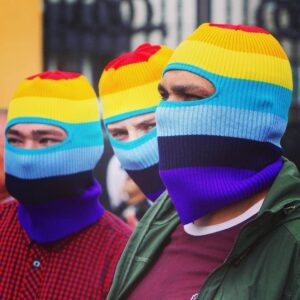
The symbols of protest style – from the blue spectacles of nihilists to the berets of the Black Panthers, from punk patches to the rainbow balaclavas of queer activists – come with history and context.[27] Wearing such signs implies understanding their origin and functions. And this is not only aesthetics but responsibility. Supporting independent producers, cooperation, DIY practice, and conscious choice of merch are ways to preserve the political meaning of slogans and symbolism. They protect the left-wing visual code from absorption by the market. The countercultural legacy of beatniks and hippies, the utilitarianism of skinheads, and the Black Bloc tactic have mixed with modern ethical production practices and sustainable forms of solidarity. Fashion remains the market’s ability to turn ideas and meanings into commodities. Style will always be a means for the movement to preserve its cultural autonomy.
NOTES
[1] The Great French Revolution (1789–1799) – the largest transformation of France’s social and political system, leading to the destruction of absolute monarchy and the proclamation of a republic. Sans-culottes (Fr. sans-culottes – ‘without culottes’, literally ‘without breeches’) – representatives of the lower classes who wore long pantalons instead of the aristocrats’ short culottes; their style also included a short carmagnole jacket and wooden sabots. The Phrygian cap – a red headgear with the top bent forward, a symbol of freedom; in Ancient Rome, it was worn by freed slaves.
[2] Beat Generation (Beats) – a literary and cultural movement of the 1950s in the USA. Key figures: Jack Kerouac (1922–1969), Allen Ginsberg (1926–1997), William S. Burroughs (1914–1997) – authors of cult works that openly addressed themes of sexuality, drugs, spiritual search, and break from bourgeois morality.
[3] Détournement (Fr. ‘diversion’, ‘hijacking’) – the seizure and inversion of existing cultural elements to subvert their original meaning.
[4] Situationist International – an avant-garde revolutionary movement of the 1950s–1960s uniting artists, intellectuals, and political theorists. It criticised modern capitalist society as the ‘society of the spectacle’, where authentic life is replaced by its representation and consumption of images.
[5] DIY (Do It Yourself – ‘do it yourself’) – an approach based on independent creation of things, music, art without the involvement of professionals or commercial structures.
[6] Let It Rock / SEX / Seditionaries – a series of names for the legendary London shop at 430 King’s Road, opened by Vivienne Westwood (1941–2022, British fashion designer) and Malcolm McLaren (1946–2010, music manager and impresario) in 1971. The shop was successively called Let It Rock (1971–1972), Too Fast to Live, Too Young to Die (1972–1974), SEX (1974–1976), Seditionaries (1976–1980), and finally World’s End (from 1980). It became a cultural laboratory for the punk movement. Sex Pistols – a British punk rock band formed in 1975, key to the development of punk culture.
[7] Guy Debord (1931–1994) – French philosopher, theorist, founder of the Situationist International. Author of the book ‘The Society of the Spectacle’ (La Société du spectacle, 1967), where he described modern society as a space where social relations are mediated by images, and reality is replaced by its representation. Recuperation (récupération) – a key concept in Debord: the process by which the system absorbs and neutralises criticism, turning it into a commodity or element of the spectacle.
[8] Black Bloc – a protest tactic where participants dress in black, hide their faces, and act as an anonymous group. It originated in West Berlin in the early 1980s among autonomous left activists and squatters – people who occupied empty buildings for housing and creating autonomous spaces.
[9] Ronald Reagan (1911–2004) – 40th President of the USA (1981–1989). His visit to West Berlin on 12 June 1987 became famous for the speech at the Brandenburg Gate calling on Mikhail Gorbachev to ‘tear down this wall’ (the Berlin Wall).
[10] The 1999 Seattle protests against the WTO (World Trade Organization) – mass anti-globalisation demonstrations during the WTO ministerial conference, known as the ‘Battle of Seattle’. They became a turning point in the history of the anti-globalisation movement.
[11] Gait recognition (Eng. ‘gait recognition’) – biometric technology for identifying people by their characteristic way of walking.
[12] Surveillance (Eng. ‘surveillance’) – systematic monitoring of behaviour, activities, or information. In the context of protests – the use of cameras, facial recognition, tracking digital traces to identify activists.
[13] Skinheads – a youth subculture that emerged at the end of the 1960s in Britain’s working-class districts. Initially apolitical, formed under the influence of mods (a British 1960s subculture cultivating neatness, modern music, and scooters) and Jamaican rude boys associated with ska and reggae music. In the 1970s, part of the movement was politicised by neo-Nazis, but apolitical and anti-racist skinheads existed in parallel.
[14] Working class chic (Eng. ‘working-class chic’) – aesthetics based on neat working-class clothing. Fred Perry – a British sportswear brand founded by tennis player Fred Perry, known for polos with a laurel wreath. Ben Sherman – a British shirt brand popular among mods and skinheads. Harrington – a light jacket with tartan lining, named after a TV series character. Braces (Eng.) – suspenders.
[15] SHARP (Skinheads Against Racial Prejudice – ‘Skinheads Against Racial Prejudice’) – an international anti-racist skinhead movement that emerged at the end of the 1980s in New York. RASH (Red and Anarchist SkinHeads – ‘Red and Anarchist Skinheads’) – the left wing of the skinhead movement adhering to socialist and anarchist views.
[16] NSDAP (Nationalsozialistische Deutsche Arbeiterpartei) – National Socialist German Workers’ Party, the Nazi party of Germany (1920–1945) led by Adolf Hitler. Lonsdale – a British brand of boxing clothing and equipment founded in 1960.
[17] Since 2006, Lonsdale has run campaigns supporting migrants and LGBTQ+, distancing itself from neo-Nazis. In 2020, Fred Perry publicly rejected association with Proud Boys (an American neo-fascist organisation founded in 2016), asking them not to wear the brand’s products.
[18] Autonome Nationalisten (Ger. ‘Autonomous Nationalists’) – neo-Nazi groups in Germany (emerged in the early 2000s) that copied the aesthetics of left-wing autonomists: black clothing, hoods, graffiti banners, and Black Bloc tactics. ‘Keffiyeh’ – a black-and-white checkered scarf that became a symbol of Palestinian resistance and later adopted by left-wing solidarity movements.
[19] NPD (Nationaldemokratische Partei Deutschlands – National Democratic Party of Germany) – a far-right political party in Germany founded in 1964 adhering to neo-Nazi views.
[20] Preppy (from preparatory school – ‘preparatory school’) – the aesthetics of American elite youth: neat classic clothing (polos, chinos, loafers) associated with the Ivy League and upper middle class.
[21] Identity Evropa (later renamed American Identity Movement) – an American neo-Nazi organisation (2016–2019) that used preppy aesthetics. Unite the Right rally in Charlottesville – a far-right march in Charlottesville, Virginia, 11–12 August 2017, which ended in violence and the death of counter-protester Heather Heyer. Proud Boys – an American neo-fascist organisation founded in 2016 using the aesthetics of ‘Western chauvinism’.
[22] David Duke (b. 1950) – American white nationalist, former Grand Wizard of the Ku Klux Klan, politician. In the 1970s, he began a strategy of normalising racism by changing image: replacing traditional KKK white hoods with suits and ties to create a ‘respectable’ appearance.
[23] Robert Rundo (b. 1990) – American white nationalist, founder of Rise Above Movement (RAM, 2017) – a violent white nationalist group that participated in clashes in Charlottesville. In 2020, he developed the Active Clubs concept, relying on the Great Replacement theory popular among current Finnish ruling politicians – a conspiracy idea that elites are organising a plot to ‘replace’ white European population with non-white immigrants. Active Clubs – a decentralised transnational network of white nationalist ‘sports clubs’ combining MMA training with neo-Nazi ideology. Founded in January 2021.
[24] Will2Rise and Media2Rise – clothing brands and media companies associated with Robert Rundo promoting white nationalism aesthetics under the guise of fitness culture. They use hidden fascist symbols: stylised fasces (symbol of power in Ancient Rome borrowed by fascists), Sonnenrad (‘sun wheel’, an occult SS symbol), slogan Me Ne Frego (‘I don’t care’, slogan of Italian fascists).
[25] According to data from the Global Project Against Hate and Extremism for 2025–2026, Active Clubs operate in at least 27 countries worldwide.
[26] Fair trade – a movement for ethical trade ensuring decent pay for producers and sustainable production conditions.
[27] Black Panthers (Black Panther Party) – a radical African-American organisation (1966–1982) fighting for civil rights and against police violence. Recognisable uniform: black berets, leather jackets, black trousers.