
Joensuu Skaters of the 1990s: From Subculture to Self-Organization
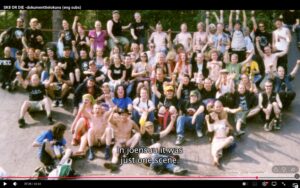
In the early 1990s, Finland experienced its deepest economic recession since World War II. In Joensuu – the center of North Karelia’s forestry industry – the impact was particularly severe. Major production facilities, such as the Joensuun Selluloosa factories, were shut down, leading to mass layoffs. The unemployment rate in the region exceeded 20%. The public atmosphere was saturated with anxiety and uncertainty. At the same time, Migri directed about 200 refugees from Somalia to Joensuu, fleeing civil war. Their arrival in a depressed region that had no experience with multiculturalism increased tensions. The typical claims about refugees circulating in society were: they “live off our taxes,” “don’t want to work,” “don’t integrate.” The inexperience of authorities and the sudden influx of migrants sparked a wave of scandalous headlines in tabloids, which fueled Islamophobia, hatred toward refugees and racism. Against this backdrop, organized racist groups began forming in Joensuu in the mid-1990s. Specific names of the groups are not mentioned in the research, but participants directly call them “natsit” and “skinit.” Alongside this, another group was forming in the city – young people united by skateboarding. Their path from interest in skating to confrontation with neo-nazis became a local but vivid episode in Finland’s social history. This text is based on interviews with conflict participants collected by Janne Tanskasen for the study “Oman tien rullaajat” (2011) and the documentary film “Sk8 or Die.” Joensuu’s skate scene centered around the only specialized shop, The Spot Boardshop, which became its headquarters. Its owner, former skater Jarmo Kuosmanen, created not just a shop but an informal youth club where one could watch videos, discuss news, and get advice. According to participants’ estimates, the active core of skaters in the city comprised several dozen people. They were opposed by a more numerous and organized nazi-skinhead group. It included “pikku-skinejä” – schoolchildren who adopted the adults’ ideology and behavior patterns. The nazi-skinhead movement in Joensuu was not amorphous. Skaters’ interviews confirm its structure. They speak of nazis with an internal hierarchy, even mentioning a “presidentti” of local groups. They had “natsiautoja” with which they patrolled the city and its surroundings looking for victims. Their presence on the streets was clearly visible. This organization transformed scattered acts of violence into a system of street terror. Besides visible attacks, such as the beating of a dark-skinned foreign athlete in the city center, there was a hidden layer of violence against migrants in the outskirts – beatings, intimidation, vandalism – which neither police nor press learned about. At this time, racism became a tangible everyday threat: parents were afraid to let their children go to school alone, and anyone who stood out in appearance or style risked becoming the next victim. In an atmosphere of constant danger, solidarity formed among all those whom the nazis saw as “others.” The reason for hatred was the skaters’ very appearance. The foundation of this subculture was purely practical and grew from scarcity. Many had no money for new skateboards or brand-name items. Broken decks were sawed narrower to match new fashion, and old wide wheels were ground down on school lathes. Worn-out skate shoes were taken to cobblers Piirojnen or Lehikoinen, who sewed them with bizarre but sturdy stitches. Their style – enormous baggy pants, bucket hats, bright knit caps that they refused to take off even at school – was a direct antithesis to the brutal militaristic image of nazi-skinheads. It was a clash of images. Toni: “I remember when I was at Karsikko school and was the baggy-pants kid in that pilot group. I got a real beating, and one of those guys’ older brother was some kind of president of the Joensuu nazis. I was scared! I’ve got trouble with the worst of them and I’m only twelve!” Jussi: “Well, that caused terrible problems. We were bullied at school just for wearing baggy pants. People in that part of Finland didn’t get it. To them a guy in those pants was a drug dealer – that’s what they’d shout while beating us up. They’d tear our clothes because those pants drove them crazy. They wore regular boots in winter, and we wore skate shoes year-round, and sometimes they’d spit all over our shoes during a single lesson. They hated our baggy pants.” The violence was not domestic but ideological. Skaters were attacked as representatives of a hostile culture. While for most the confrontations were street-level, some skaters made a conscious choice for organized resistance. The key figure here was Ville, who said he joined an antifascist organization (Antifa-järjestö – the specific name is not mentioned in the interview). His account shows a qualitative transition: from victim of sporadic violence to target of systematic persecution. Ville: “At some point it got really bad – they started recognizing our faces, so there was nowhere you could feel safe. Once we went swimming at Onttola, which is 10 kilometers from Joensuu. We come out of the water and head to the car, and suddenly a nazi car pulls up alongside and they come piling out. We barely managed to lock the doors, and they tried to smash the windows and tip the car over, shouting: ‘Open up!’ In the middle of the day at a swimming beach. They were actively hunting people like us. I was doing civilian service at the youth center at the time and they came looking for me there too. They found out my address and I had to move out because they’d come knocking on the windows at home. At some point it just got too much – I couldn’t go anywhere without means of self-defense or be somewhere alone. It was, to put it mildly, fucking insane.” The conflict escalated to serious bodily injuries: “I ended up in hospital multiple times because of stabbings and so on. Ten stitches in my hand. A knife here and a knife there. Pretty rough – it left its mark.” The struggle was also waged over physical space. Homemade skate ramps that skaters built from plywood “borrowed” from construction sites were symbols of their autonomy. These structures were systematically destroyed: less often by city services, more often by ideological opponents. Not only by far-right groups but also by “ordinary Finnish guys.” Jukka: “Yeah… the guys who played hockey or football looked at us like shit… and wrecked our stuff. Idiots drove cars over them… or burned them.” The most notorious incident occurred in the new Marjala district, where in 1995 large asphalted areas with ready-made curves and drains, ideal for skating, were poured for a housing exhibition. There, skaters built together a massive vert ramp. It was burned down shortly after completion. As noted in the study with reference to M. Jaakkola’s 1994 work, hate crimes were often hushed up or treated as hooliganism during that period. The problem was officially recognized only after a public scandal involving an attack on American basketball player Ulysses Ashley in 1994. He was brutally kicked by several nazi-skinheads in central Joensuu. This incident received widespread publicity, as the athlete was forced to terminate his contract with the local club Joensuun Kataja prematurely and leave Finland. The pressure from common enemies – nazi-skinheads and the conservative majority – united Joensuu’s diverse “alternative” youth. Ville: “In Joensuu, like in many small towns, the alternative scene wasn’t divided. In bigger cities you have a punk scene, a rap scene, a metal scene – in Joensuu it was all one and the same. All the alternative types hung out together. They were the same crowd. And it was pretty well reinforced by the fact that there were the nazis, and then there was the alternative crowd. That brought people together. It was a cool thing, that sense of belonging.” After 1998, the peak of neo-Nazi street violence had passed, and their activity began to decline. Simultaneously, skateboarding became commercial mainstream, municipal skate parks appeared (the first in Joensuu – in 2000), and mass brands like DC Shoes filled the market. The Spot shop couldn’t withstand competition from chain stores like Dutch and closed in 2004. The era of street confrontation was over. But not forgotten. The story of Joensuu skaters is a concrete example of how, under conditions of social breakdown and rising xenophobia, youth initially far from politics becomes drawn into ideological struggle. Their antifascism was born from experience: from beatings for the cut of their pants, from burned ramps, from the need to protect friends and walk looking over their shoulders. They didn’t plan to become activists, but their everyday practices came into irreconcilable contradiction with street violence and the ideology of hatred. The skaters’ resistance, though passive and local, was part of a broader social conflict, a struggle over the future of 1990s Finland. Which was waged not only in parliament but also on asphalted wastelands.